How to Clean Your Dog's Teeth at Home: 7 Easy Steps + Best Products
Affiliate Disclosure: As an Amazon Associate, we earn from qualifying purchases.
Want to learn how to clean your dog's teeth at home without turning it into a daily struggle? You're in the right place.
Dental care is an essential part of keeping your dog healthy, but many pet parents don't realize how important it is until they notice bad breath, yellow buildup, or irritated gums.
The good news is that a gentle, consistent dental-care routine can help reduce plaque and support healthier teeth and gums.
You don't need expensive equipment to get started. A soft toothbrush, dog-safe toothpaste, patience, and a few minutes of practice can make a meaningful difference.
In this guide, you'll learn:
- How to brush your dog's teeth in seven simple steps.
- Which dental products are useful and which are optional.
- How often you should clean your dog's teeth.
- Why dental chews cannot completely replace brushing.
- How to recognize dental problems that require veterinary attention.
Let's start with the basics.
Why Is Dental Care So Important for Dogs?
Just like people, dogs develop plaque on their teeth.
Plaque is a sticky film containing bacteria that accumulates on tooth surfaces.
If plaque isn't removed regularly, it can contribute to gum inflammation and mineralize into tartar.
Over time, dental disease can cause pain, infection, and tooth loss.
The American Veterinary Medical Association (AVMA) identifies regular toothbrushing as the most effective home-care method for maintaining a pet's dental health between professional cleanings.
Daily brushing is ideal, although brushing several times per week can still be beneficial.
Professional dental examinations remain important because some problems develop beneath the gumline, where they cannot be detected or treated through home brushing alone.
What You'll Need to Clean Your Dog's Teeth at Home
Before you begin, gather a few simple supplies.
1. A Soft Dog Toothbrush
Choose a soft-bristled toothbrush that fits comfortably inside your dog's mouth.
Small dogs may benefit from a compact brush head.
A finger brush can help some dogs become familiar with mouth handling, although a regular soft-bristled brush may provide better access to certain teeth.
2. Dog-Safe Toothpaste
Always use toothpaste specifically formulated for pets.
Human toothpaste may contain ingredients that are unsafe for dogs, including xylitol in some formulations.
Never assume that a product is safe just because it is labeled natural.
3. Small Rewards
Positive reinforcement can make brushing easier.
Choose small, appropriate rewards your dog enjoys.
4. A Quiet Environment
Pick a comfortable location with minimal distractions.
Avoid restraining your dog forcefully.
If your dog appears frightened or painful, stop and consult your veterinarian.
How to Brush Your Dog's Teeth in 7 Easy Steps
Step 1: Help Your Dog Feel Comfortable
Begin by gently touching your dog's cheeks and muzzle.
Reward calm behavior.
Don't immediately try to open the mouth or insert a toothbrush.
Your first goal is to help your dog feel comfortable with handling.
Step 2: Introduce Dog Toothpaste
Place a small amount of pet-safe toothpaste on your finger.
Allow your dog to investigate it voluntarily.
If your dog dislikes the flavor, consider another veterinarian-approved option.
Never force toothpaste into your dog's mouth.
Step 3: Practice Lifting the Lips
Gently lift one side of your dog's upper lip.
Reward your dog for remaining relaxed.
Repeat on the other side.
Keep sessions short and positive.
Step 4: Introduce the Toothbrush
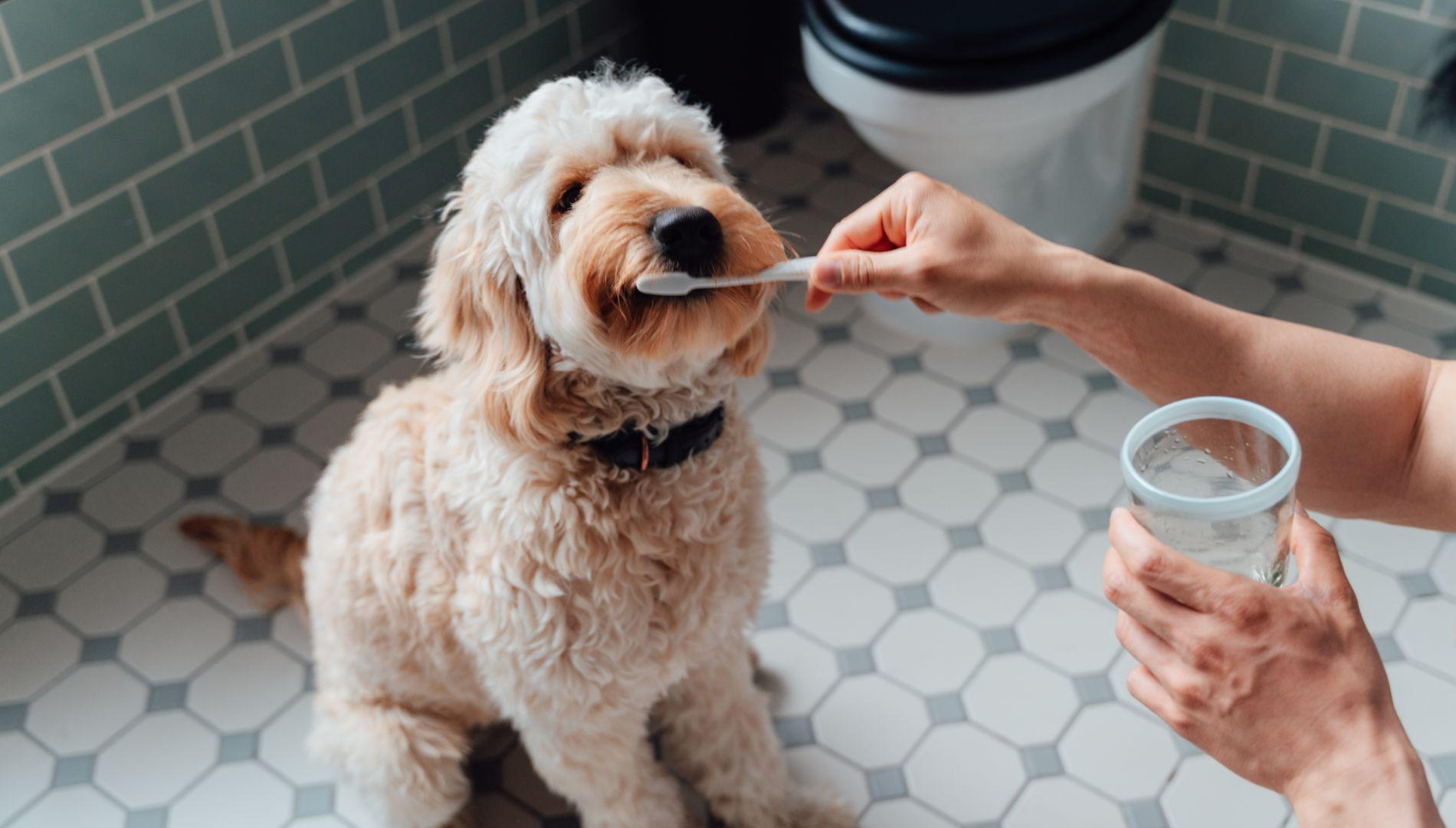
Let your dog see and sniff the toothbrush.
Touch the brush gently to one or two teeth.
Use very light pressure.
If your dog pulls away, return to an easier step.
Step 5: Brush the Outer Tooth Surfaces
Once your dog accepts the brush, focus on the outer surfaces of the teeth, particularly near the gumline.
Use gentle, small circular motions or short strokes.
Avoid aggressive scrubbing.
The outer surfaces of the back teeth are especially important because plaque commonly accumulates there.
Step 6: Gradually Increase Brushing Time
You don't need to brush every tooth during the first session.
Start with a few seconds and gradually work toward a more complete routine as your dog becomes comfortable.
Focus on consistency rather than speed.
Step 7: Reward Your Dog and Repeat Regularly
Finish with praise or another appropriate reward.
Aim for daily brushing when possible.
If daily brushing isn't realistic, establish the most consistent schedule your dog will tolerate and discuss additional dental-care options with your veterinarian.
Remember: Never force a painful or frightened dog to accept toothbrushing.
Best Dog Dental Care Products to Consider
A toothbrush and pet-safe toothpaste are the foundation of home dental care.
Additional products may help support oral hygiene, but they should not be treated as replacements for veterinary dental examinations.
1. Virbac C.E.T. Enzymatic Toothpaste — Best for a Daily Brushing Routine
Virbac C.E.T. Enzymatic Toothpaste is formulated for dogs and cats.
Its poultry-flavored version is designed to make brushing more acceptable to pets that enjoy savory flavors.
The product uses an enzymatic formulation intended to support oral hygiene.
Pros
- Formulated for pets.
- Poultry flavor may improve acceptance.
- Designed for use with a toothbrush.
- Suitable for establishing a daily brushing routine.
Cons
- Some dogs may dislike the flavor.
- Requires gradual training for dogs unfamiliar with brushing.
- Does not replace professional dental cleaning.
Our verdict: A practical toothpaste option for owners starting a regular brushing routine.
CHECK VIRBAC C.E.T. TOOTHPASTE ON AMAZON
2. Petsmile Professional Pet Toothpaste — Best VOHC-Accepted Toothpaste Option
Petsmile Professional Pet Toothpaste is included on the Veterinary Oral Health Council's accepted-products list for plaque control.
The VOHC seal indicates that submitted product data met the council's criteria for the specific dental claim.
Petsmile may be worth considering for owners looking for a toothpaste with documented plaque-control acceptance.
Pros
- VOHC acceptance for plaque control.
- Designed for pets.
- Available in different flavors.
- Can complement a regular dental-care routine.
Cons
- Some dogs may reject particular flavors.
- Product versions and availability can vary.
- Professional dental care may still be required.
Our verdict: A useful alternative for owners who prioritize a product carrying the VOHC seal.
CHECK PETSMILE TOOTHPASTE ON AMAZON
3. Greenies Original Dental Treats — Best for Supplemental Dental Chews
Greenies Original Dental Treats are among the recognizable dental chews designed for dogs.
The canine Greenies product family appears on the VOHC accepted-products list for plaque and tartar control.
Dental chews may help supplement a home oral-care routine, especially when selected according to the dog's size and chewing habits.
Pros
- VOHC-accepted product family.
- Available in several sizes.
- Convenient supplemental dental care.
- Many dogs enjoy chew-style treats.
Cons
- Adds calories to the diet.
- Must be matched to the dog's size.
- Requires supervision.
- Cannot replace regular toothbrushing.
Our verdict: A reasonable supplemental option for dogs that can safely chew appropriately sized dental treats.
Amazon affiliate link: https://link.amazon/B035lwTT8
4. OraVet Dental Hygiene Chews — Best Alternative Dental Chew
OraVet Dental Hygiene Chews are another product listed by the VOHC for tartar control.
They are intended to be used according to the manufacturer's weight-based recommendations.
Dental chews should always be supervised, especially with dogs that swallow treats quickly.
Pros
- VOHC acceptance for tartar control.
- Multiple weight-based sizes.
- Convenient supplemental dental care.
Cons
- Not suitable for every dog.
- Requires careful size selection.
- Adds calories.
- Does not replace brushing.
Our verdict: Worth discussing with your veterinarian if you're looking for an additional dental chew.
Amazon affiliate link: https://link.amazon/B0eIX1bPY
5. TropiClean Fresh Breath Dental Water Additive — Best Supplemental Water Additive
TropiClean Fresh Breath Dental Water Additive for Dogs is included on the VOHC accepted-products list for plaque control.
The product is designed to be added to drinking water according to its label instructions.
Water additives can be convenient, but they should be treated as supplements rather than substitutes for brushing.
Pros
- VOHC acceptance for plaque control.
- No toothbrush required for application.
- Convenient for some households.
- May complement a broader dental-care routine.
Cons
- Doesn't replace mechanical plaque removal through brushing.
- Dogs may react differently to changes in water taste.
- Correct dosing is important.
- Owners must monitor normal water intake.
Our verdict: A possible addition to a dental-care routine when recommended by your veterinarian and used according to the label.
Amazon affiliate link: https://link.amazon/B08Yp8mhW
How Often Should You Brush Your Dog's Teeth?
Daily toothbrushing is the ideal goal.
Plaque forms continuously, so regular removal helps reduce buildup.
The AVMA recommends daily brushing when possible and recognizes that brushing several times a week can still be effective.
If your dog is new to brushing, focus on gradually building a positive routine.
Consistency matters more than forcing a complete cleaning immediately.
How to Clean a Dog's Teeth That Won't Let You Brush
Some dogs are uncomfortable with mouth handling.
This is especially common when brushing is introduced suddenly or when a dog has existing dental pain.
Start with gentle training:
- Reward your dog for allowing you to touch their muzzle.
- Gradually introduce lip lifting.
- Allow them to investigate pet-safe toothpaste.
- Introduce a toothbrush for a few seconds.
- Increase contact only when your dog remains relaxed.
If your dog reacts aggressively, cries, or appears painful, stop and arrange a veterinary examination.
Dental chews, approved dental diets, and other VOHC-accepted products may provide additional support, but they are not equivalent to brushing.
How to Remove Tartar From Dog Teeth at Home
This is an important distinction.
Plaque and tartar are not the same thing.
Plaque is a soft bacterial film that can be disrupted by regular brushing.
Tartar, also called dental calculus, is hardened mineralized buildup.
Once tartar has formed, brushing alone generally cannot remove it effectively.
Do not scrape your dog's teeth with metal instruments or attempt professional-style dental scaling at home.
Improper scraping can damage teeth or gums and cause injury.
A veterinarian can assess whether professional cleaning is necessary.
Can You Use Human Toothpaste on Dogs?
No.
Human toothpaste is not designed to be swallowed by dogs.
Some products contain xylitol, which is highly toxic to dogs.
Other ingredients may also be inappropriate for pets.
Use only toothpaste formulated for dogs or other products specifically recommended by your veterinarian.
Avoid homemade mixtures involving baking soda, essential oils, or other ingredients unless your veterinarian has approved them.
Signs Your Dog Needs a Professional Dental Examination
Home brushing is useful for prevention, but it cannot diagnose every dental problem.
Contact your veterinarian if you notice:
- Persistent bad breath.
- Red, swollen, or bleeding gums.
- Loose or broken teeth.
- Difficulty chewing.
- Dropping food.
- Excessive drooling.
- Reduced appetite.
- Facial swelling.
- Visible pain around the mouth.
These signs may indicate dental disease or another health problem.
Do not attempt to brush painful areas aggressively.
Are Dental Chews as Effective as Brushing?
Dental chews can be helpful additions to an oral-care routine.
However, they are not equivalent to daily toothbrushing.
The effectiveness of a chew depends on its design, how the dog uses it, and the evidence supporting its dental claims.
Look for products with the Veterinary Oral Health Council Seal of Acceptance.
A VOHC seal applies to specific products and claims, not automatically to every product sold by the same brand.
Always supervise chewing and choose the appropriate size.
Dental Care for Small Dogs
Small dogs can be especially challenging to brush because of their compact mouths.
Choose a small, soft-bristled toothbrush and take your time.
For breeds such as Maltipoos, Chihuahuas, Yorkshire Terriers, and Toy Poodles, regular dental examinations are particularly important.
Your veterinarian can help identify crowding, retained baby teeth, periodontal problems, and other concerns.
A Simple Weekly Dog Dental Care Routine
| Frequency | Dental Care Task |
|---|---|
| Daily, ideally | Brush with dog-safe toothpaste |
| As directed | Use veterinarian-approved dental chews or other products |
| Regularly | Check for changes in breath, gums, and chewing |
| At least annually | Arrange a veterinary dental examination |
| When symptoms appear | Contact your veterinarian promptly |
Your veterinarian may recommend a different examination schedule based on your dog's age, breed, and dental health.
Frequently Asked Questions
What is the easiest way to clean a dog's teeth at home?
Start with a soft dog toothbrush, pet-safe toothpaste, and short, positive training sessions. Gradually build toward regular brushing.
Can I clean my dog's teeth without brushing?
Dental chews, certain dental diets, and approved water additives may help, but brushing remains the most effective routine home method for removing plaque.
How do I get yellow tartar off my dog's teeth?
Hardened tartar generally requires professional veterinary cleaning. Do not attempt to scrape it off yourself.
How often should I brush my dog's teeth?
Daily is ideal. Brushing several times a week can still be beneficial if daily brushing is not possible.
What toothpaste is safe for dogs?
Use toothpaste specifically formulated for pets. Avoid human toothpaste, particularly products containing xylitol.
Can dental chews replace brushing?
No. They can complement brushing but should not be considered an equivalent replacement.
Why does my dog have bad breath?
Persistent bad breath may be a sign of dental disease or another health concern. A veterinarian should assess ongoing or worsening symptoms.
Is professional dog dental cleaning necessary?
Some dogs require professional cleaning to remove tartar and address disease below the gumline. Your veterinarian can determine when treatment is needed.
Can puppies have their teeth brushed?
Puppies can gradually become accustomed to gentle mouth handling and pet-safe brushing. Ask your veterinarian about age-appropriate products and techniques.
What if my dog refuses toothbrushing?
Use gradual positive-reinforcement training and avoid force. If your dog shows signs of pain or extreme distress, consult your veterinarian.
Final Thoughts: Healthy Dog Teeth Start With a Consistent Routine
Learning how to clean your dog's teeth at home is one of the most useful steps you can take toward better long-term oral health.
You don't need to master the entire process in one day.
Start slowly, use dog-safe products, reward cooperation, and build a routine your dog can tolerate comfortably.
Daily brushing is the ideal foundation.
Appropriate dental chews, VOHC-accepted products, and professional veterinary examinations can provide additional support.
Most importantly, remember that persistent bad breath, bleeding gums, and difficulty eating are reasons to seek veterinary advice.
A few minutes of gentle dental care today can help support a healthier mouth tomorrow.
Veterinary References
American Veterinary Medical Association — Pet Dental Care
Veterinary Oral Health Council — Accepted Products
https://vohc.org/accepted-products/
Veterinary Oral Health Council — About the VOHC Seal
This article is for educational purposes and does not replace individualized veterinary advice.
Editorial note: Product recommendations are based on published information and recognized dental-care resources, not independent hands-on testing.