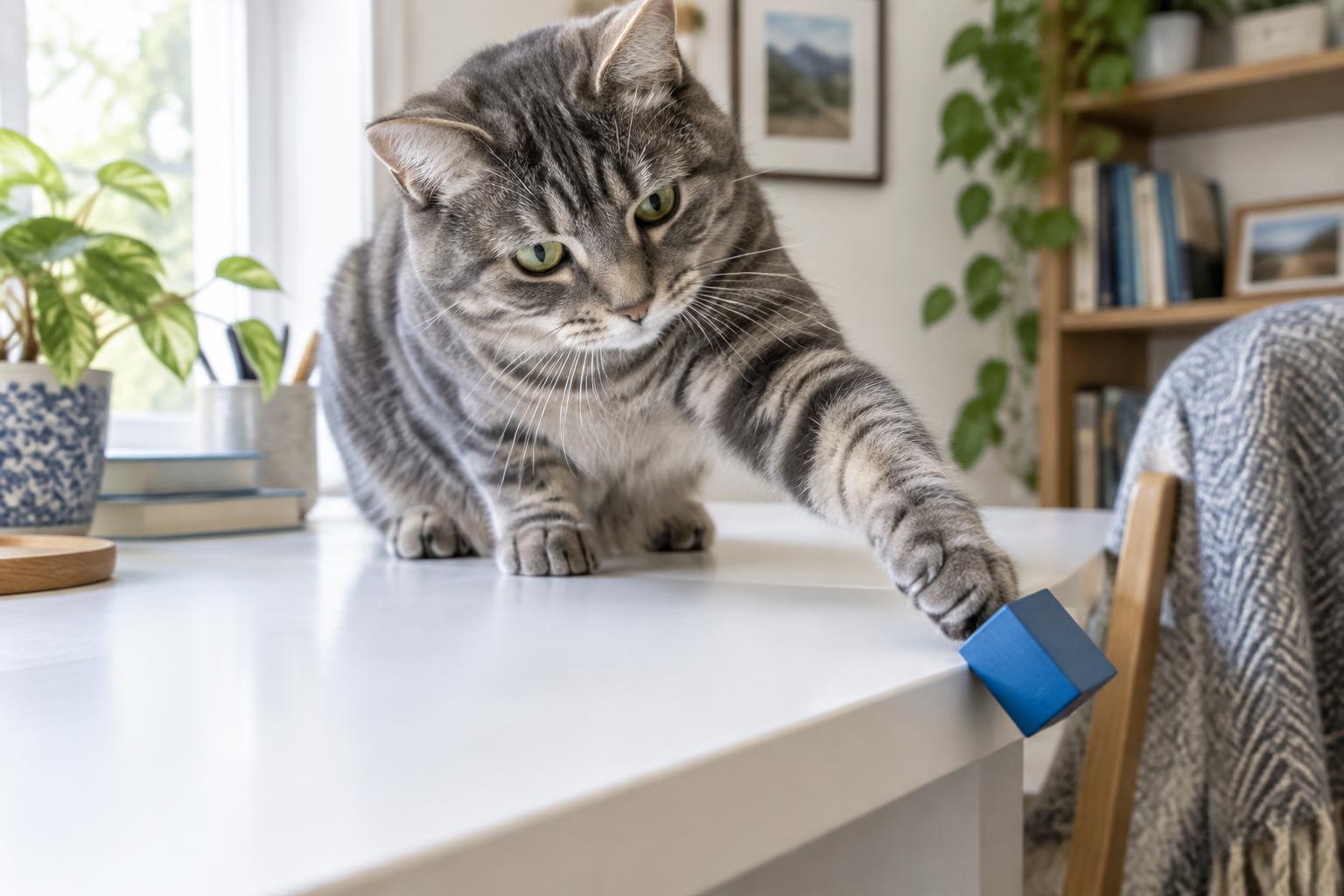
If you live with a cat, chances are you’ve experienced the ultimate display of feline audacity: your cat looks you dead in the eye, slowly places a paw on a pen, a cup, or your phone, and watches it crash to the floor.
It feels personal. It feels like malice. But popular cat behavior experts and ethologists in the United States explain that this hilarious quirk is actually deeply rooted in natural instinct and pure curiosity.
It’s not spite — it’s science
Cats don't possess human concepts of spite or property damage. When a cat knocks an object off a ledge, several fascinating psychological and physical factors are at play:
1. The Prey Drive in Disguise
Evolutionarily, cats are supreme hunters. Their brains are hardwired to notice movement and test whether something is alive. When a cat bats at an object, they are testing the "prey response": Does it move? Does it scurry away? Is it alive?
2. Pure Cause-and-Effect Experimentation
Cats are remarkably smart scientists. They love figuring out how the world works. When they touch an object and it falls, they learn a clear rule of physics: Paw goes out $\rightarrow$ object goes down $\rightarrow$ gravity happens. Repeating the action is just them testing if the outcome remains consistent.
3. The Ultimate Attention Getter
Let’s be honest: cats quickly learn that knocking your coffee mug or glasses off the nightstand gets an immediate reaction. Whether you gasp, jump out of bed, or scold them, to a cat, any reaction is a rewarding reaction. In their minds, "bad attention" still means playtime or engagement.
How to handle the "feline physicist" at home
While it's funny on video, it can be expensive or dangerous if fragile items are involved. Here is how to manage it:
- Don't reward the behavior: If your cat knocks something over to get you out of bed, avoid giving dramatic reactions. Clean it up quietly.
- Provide alternative outlets: Channel that paw-eye coordination into interactive wand toys or puzzle feeders so they can satisfy their hunting instincts safely.
- Clear the ledges: Keep valuable or dangerous items (like glass decor or toxic plants) out of their primary exploration paths.
Cats turn ordinary living rooms into their own personal science laboratories. Does your cat have a favorite item they love to knock over? Let us know in the comments!