Why Does My Dog Get Between Us When We Hug? The Science Behind Canine Jealousy
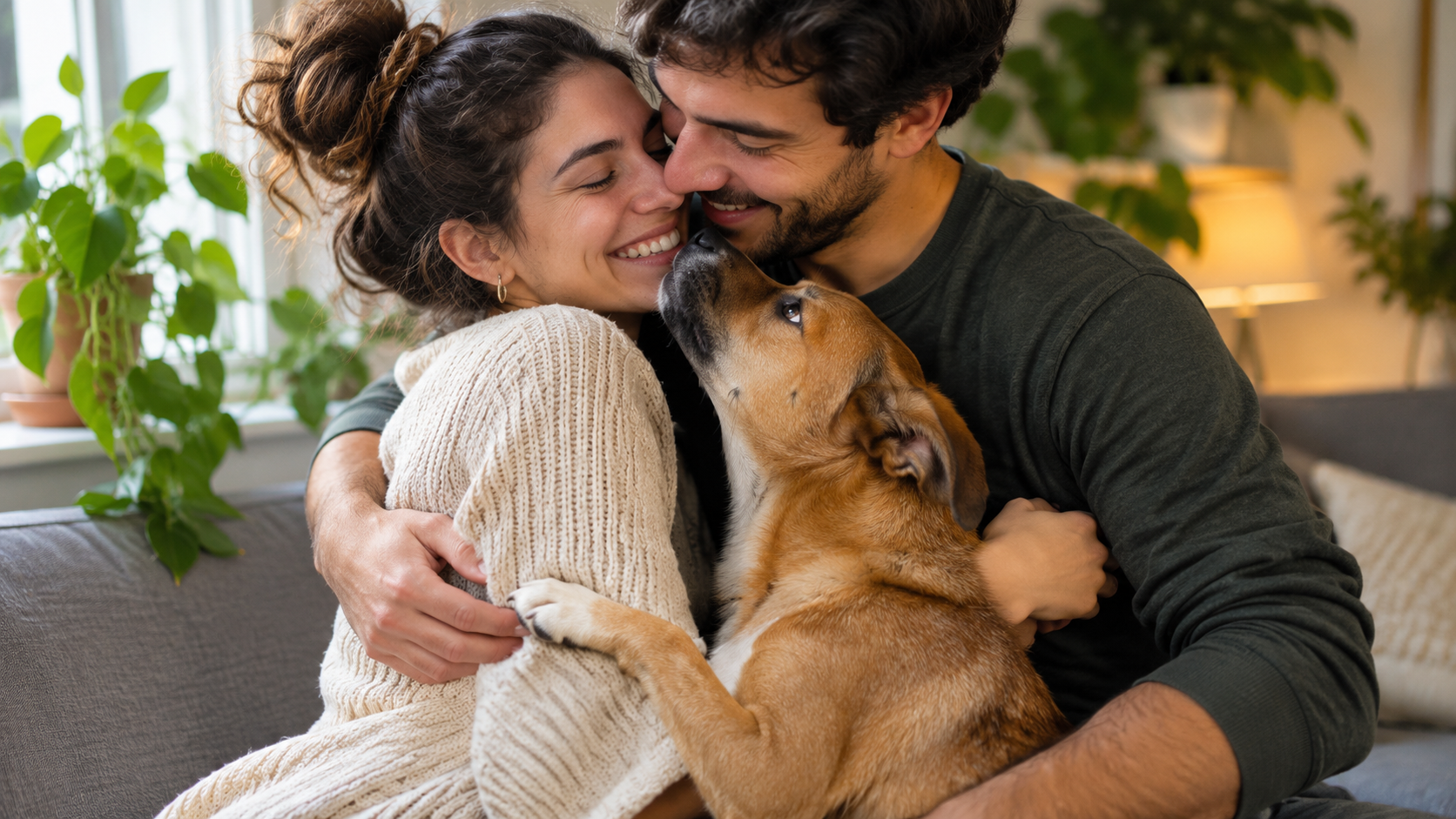
You hug your partner, and within seconds, your dog appears between you. Maybe they push their nose against your legs, wag their tail, jump up, or insist on becoming part of the embrace.
Sound familiar?
Many dog owners interpret this behavior as jealousy. Others believe their dogs simply want to participate in a family moment.
But what is actually happening in your dog's mind?
Scientific research into canine emotions, attachment, and social behavior offers some fascinating explanations. The truth is more complex than either a simple expression of jealousy or an innocent desire for affection.
Understanding the difference can help you strengthen your relationship with your dog while encouraging healthier behavior.
The Short Answer: Why Does My Dog Interrupt Our Hugs?
Your dog may interrupt hugs because they want attention, enjoy being included in social interactions, feel uncertain about your body language, or react to a perceived competitor for your affection.
Several of these motivations can exist at the same time.
Although scientific experiments suggest that dogs can display jealousy-like behaviors, interrupting a hug does not automatically mean your dog is jealous.
To understand the behavior, you need to consider your dog's body language, previous experiences, and reactions in similar situations.
1. Your Dog Wants to Be Included
Dogs are social animals that develop meaningful relationships with their human caregivers.
When two familiar people suddenly engage in an affectionate interaction, a dog may approach simply because something socially interesting is happening.
Imagine a dog resting peacefully on the living room floor. Two family members stand up, move closer together, smile, and embrace.
From the dog's perspective, this interaction may represent an opportunity to receive attention or participate in an enjoyable moment.
A relaxed body, soft facial expression, and gentle approach can be consistent with friendly social interest.
However, the idea that your dog is trying to join a human "pack hug" remains an interpretation rather than a scientifically established explanation.
Dogs do not necessarily understand human embraces in the same way we do.
2. Dogs Can Display Jealousy-Like Behavior
For many years, researchers debated whether jealousy was an emotion experienced exclusively by humans.
Research into canine cognition has challenged that assumption.
The University of California Study on Canine Jealousy
In 2014, psychologists Christine Harris and Caroline Prouvost published a study titled Jealousy in Dogs in the scientific journal PLOS ONE.
The researchers compared dogs' reactions when their owners directed attention toward a realistic stuffed dog and toward nonsocial objects.
Dogs were more likely to display behaviors associated with jealousy when their owners interacted affectionately with the apparent canine rival.
These behaviors included:
- Moving between the owner and the object.
- Pushing against the owner or object.
- Snapping in some cases.
This research is particularly relevant because physically interrupting an interaction resembles what many dog owners observe during hugs.
However, the experiment did not specifically examine romantic partners or human-to-human embraces.
Its findings support the possibility of jealousy-like behavior in dogs without establishing the motivation behind every interrupted hug.
Read the original scientific study — Harris and Prouvost, 2014.
3. Your Dog May Recognize a Potential Rival for Attention
A 2021 study from researchers at the University of Auckland explored whether dogs could respond to jealousy-inducing interactions even when they could not directly see them.
The experiment, published in Psychological Science, involved 18 dogs.
Researchers compared the dogs' responses when their owners appeared to interact with a realistic artificial dog or a nonsocial control object.
The dogs showed stronger attempts to reach their owners during the apparent interaction with the artificial dog, including when that interaction was hidden behind a barrier.
The researchers identified three important characteristics:
- The reaction depended on the presence of a perceived social competitor.
- The owner's apparent interaction with that competitor mattered.
- Dogs could react even when the interaction was no longer visible.
These findings suggest that dogs may respond to competition for social attention in surprisingly sophisticated ways.
Nevertheless, the researchers cautioned against assuming that canine jealousy is identical to human jealousy.
Your dog interrupting a hug could reflect competition for attention, but the behavior alone cannot reveal exactly what emotion your dog is experiencing.
Read the original scientific study — Bastos et al., 2021.
4. Your Dog Has Learned That Interrupting Works
Sometimes, the simplest explanation is reinforcement.
Think about what happens when your dog gets between you and your partner.
Do you laugh?
Do you bend down to pet them?
Does your partner stop hugging you and begin playing with the dog?
If interrupting consistently produces something your dog values, the behavior may become more frequent.
Dogs learn through associations and the consequences of their actions.
For example, consider this sequence:
| Situation | Dog's Behavior | Possible Reward |
|---|---|---|
| Two people hug | Dog pushes between them | Both people pet the dog |
| Owner kisses their partner | Dog jumps up | Owner talks to the dog |
| Couple sits close together | Dog squeezes into the middle | Dog receives physical affection |
| Family members embrace | Dog barks | Everyone looks at the dog |
Repeated attention can reinforce the behavior, even when nobody deliberately intends to train it.
This does not mean your dog is being manipulative.
They may simply have discovered an effective way to obtain interaction.
5. Your Emotional Bond May Influence the Behavior
Dogs form attachment relationships with their human caregivers.
These relationships can provide reassurance and influence how dogs interact with their surroundings.
In 2013, researchers Lisa Horn, Ludwig Huber, and Friederike Range investigated what scientists call the secure base effect.
Their experiments found that dogs engaged more persistently with a problem-solving device when their owners were present. An unfamiliar person did not produce the same effect.
The findings demonstrate that a familiar caregiver can influence canine motivation and behavior in ways that extend beyond basic companionship.
During a hug, a dog may approach because they are naturally drawn toward someone with whom they share a strong attachment.
However, attachment alone does not explain why a particular dog interrupts an embrace.
A strong relationship can exist without constant physical proximity.
Read the original scientific study — Horn et al., 2013.
6. Your Dog May Misinterpret Human Body Language
For humans, hugging is often an expression of affection.
For dogs, the same interaction may be unfamiliar or ambiguous.
Two people standing close together, wrapping their arms around each other, and moving face-to-face can look different from ordinary human activity.
Some dogs may become excited by the movement.
Others may approach to investigate or respond to apparent tension.
An uncertain dog may show behaviors such as:
- Lip licking.
- Turning their head away.
- Lowering their body.
- Restlessness.
- Repeatedly looking between the people.
- Barking or moving away.
These signals must be interpreted in context. For example, lip licking can occur for reasons unrelated to stress.
If your dog seems uncomfortable during an embrace, avoid deliberately repeating the interaction to provoke a reaction.
Give your dog space and allow them to move away.
7. Your Dog May Be Guarding Access to You
There is an important difference between a dog that happily joins an interaction and one that attempts to prevent another person from approaching.
A playful interruption may be relatively harmless.
A tense interruption accompanied by threatening behavior deserves closer attention.
Warning signs include:
- A stiff body posture.
- Freezing when someone approaches you.
- Growling at your partner.
- Blocking another person's movements.
- Snapping or attempting to bite.
- Escalating reactions when someone touches you.
Such behavior may involve fear, conflict, guarding, or other underlying issues.
It should not automatically be interpreted as loyalty or protection.
If your dog displays these signs, do not punish the growling or deliberately challenge the dog. Manage the situation safely and seek guidance from a veterinarian or qualified canine behavior professional.
What Scientific Research Says About Jealousy in Dogs
The scientific evidence extends beyond a single experiment.
A 2018 study titled Investigating Jealous Behaviour in Dogs compared dogs' reactions when their owners directed attention toward social and nonsocial partners.
Dogs displayed more owner-directed behavior and more attempts to interrupt interactions involving other dogs than interactions involving objects.
The findings provide additional evidence that dogs distinguish between different types of competition for social attention.
Read the original scientific study, 2018.
Scientific Evidence at a Glance
| Study | Year | Main Finding |
|---|---|---|
| Horn et al., PLOS ONE | 2013 | Caregiver presence influenced dogs' engagement in a task. |
| Harris and Prouvost, PLOS ONE | 2014 | Dogs interrupted interactions involving an apparent canine rival more frequently. |
| Investigating Jealous Behaviour in Dogs | 2018 | Dogs reacted differently to social and nonsocial competitors. |
| Bastos et al., Psychological Science | 2021 | Dogs responded to apparent interactions with a rival even when hidden from view. |
Together, these studies make canine jealousy a scientifically credible possibility.
They do not establish how frequently dogs interrupt human hugs because of jealousy, nor do they prove that every dog experiences the emotion in the same way.
Is It Jealousy, Affection, or Attention-Seeking?
Observing your dog's entire behavior is more useful than focusing exclusively on the interruption.
| Behavior You Observe | Possible Interpretation |
|---|---|
| Relaxed approach and gentle nudging | Social interest or desire for attention |
| Playful movements | Excitement or expectation of interaction |
| Repeated jumping after being rewarded | Learned attention-seeking behavior |
| Lip licking and avoidance | Possible uncertainty or discomfort |
| Stiff posture and blocking | Possible tension or guarding |
| Growling or snapping | Potential safety concern requiring assessment |
These interpretations are possibilities, not diagnostic criteria.
A wagging tail alone does not guarantee that a dog is relaxed or friendly. Look at the overall posture, facial expression, movement, and context.
A Three-Day Observation Guide for Dog Owners
Rather than trying to guess your dog's emotions, spend a few days observing naturally occurring interactions in your household.
This simple exercise can help you recognize patterns without deliberately creating stressful situations.
Day 1: Observe the Trigger
Notice what happens immediately before your dog approaches.
Is it a hug, a kiss, laughter, physical movement, or a change in attention?
Does your dog react only when you embrace your partner, or also when other people hug?
Day 2: Observe Body Language
Pay attention to your dog's posture and movements.
Notice whether they appear relaxed, playful, hesitant, or tense.
Observe whether your dog can leave the interaction voluntarily.
Day 3: Observe the Consequence
Notice what your dog receives after interrupting.
Do they receive petting, verbal attention, play, or access to a preferred person?
Does the original embrace stop?
Your Observation Checklist
| What to Observe | Your Notes |
|---|---|
| Interaction that triggered the approach | |
| People involved | |
| Dog's body posture | |
| Vocalization or physical contact | |
| Human response | |
| Whether the dog settled afterward |
This is an informal observation exercise, not a validated behavioral assessment.
If your dog displays aggression or significant distress, stop observing the triggering situations and seek professional support.
How to Teach Your Dog Not to Interrupt Every Hug
You don't need to exclude your dog from family affection.
However, teaching them to remain comfortable while other people interact is a useful everyday skill.
Step 1: Create a Comfortable Resting Area
Choose a familiar mat or bed where your dog can relax near you.
Reward voluntary visits to this area.
The resting place should feel positive, not like a punishment.
Step 2: Teach a Simple Settle Cue
Practice encouraging your dog to lie down or settle on the mat.
Reward calm behavior during ordinary, distraction-free moments.
Keep training sessions short.
Step 3: Introduce Mild Distractions
Once your dog understands the routine, practice with small, everyday movements that do not cause tension.
Reward your dog for remaining relaxed.
Step 4: Introduce Brief Affectionate Interactions
If your dog is comfortable and has no history of aggression in these situations, gradually introduce brief interactions between family members.
Keep the interaction easy enough for your dog to remain relaxed.
Reward calm behavior instead of rewarding jumping or pushing.
Step 5: Make Attention Predictable
Continue providing affection, play, exercise, and companionship throughout the day.
Your dog should learn that they do not need to interrupt every interaction to receive attention.
Never use punishment, intimidation, or forced restraint to stop this behavior.
If your dog growls, snaps, or becomes extremely distressed during physical interactions between people, do not attempt this training without professional guidance.
Does Interrupting Hugs Mean My Dog Has Separation Anxiety?
Not necessarily.
Separation anxiety involves distress associated with being separated from an attachment figure or left alone.
Interrupting a hug while the owner is present does not establish that a dog has separation anxiety.
A dog can be affectionate, socially demanding, or sensitive to changes in attention while remaining comfortable when left alone.
If your dog also experiences persistent vocalization, pacing, destructive behavior, or significant distress during departures, discuss these symptoms with your veterinarian.
Should I Let My Dog Join Our Hugs?
If your dog approaches voluntarily, remains relaxed, and everyone is comfortable, there is generally nothing wrong with including them in a moment of affection.
But participation should always be voluntary.
Avoid pulling your dog into a tight embrace or preventing them from leaving.
Some dogs enjoy close physical contact, while others prefer companionship without restraint.
Respecting those individual preferences is an important part of building trust.
It is equally reasonable to teach your dog that some human interactions do not require their participation.
Frequently Asked Questions
Why does my dog get between me and my partner when we hug?
Your dog may be seeking attention, responding to an interesting social interaction, displaying jealousy-like behavior, or reacting to unfamiliar body language.
Do dogs actually get jealous?
Scientific experiments support the existence of jealousy-like behaviors in dogs. Whether dogs experience jealousy exactly as humans do remains uncertain.
Why does my dog bark when I kiss my partner?
Barking may reflect excitement, learned attention-seeking, uncertainty, or tension. Consider the dog's overall behavior and what happens after the barking.
Is my dog trying to protect me when someone hugs me?
That is one possible interpretation, but interrupting a hug is not sufficient evidence of protective motivation. Several simpler explanations may account for the behavior.
Why does my dog push my partner away?
The behavior could involve attention-seeking, social competition, discomfort, or guarding. Persistent tension or aggression requires professional assessment.
Is canine jealousy dangerous?
Jealousy-like behavior does not automatically indicate danger. However, stiff blocking, growling, snapping, or biting should be taken seriously.
Does my dog love me more if they interrupt hugs?
No reliable scientific method measures the strength of a dog's affection by how frequently they interrupt human interactions.
How can I help my dog remain calm when we hug?
Teach a comfortable settle routine using positive reinforcement and gradually introduce mild distractions. Seek professional guidance if your dog displays fear or aggression.
Final Thoughts: Your Dog May Be Asking for More Than Attention
When your dog squeezes between you and someone you love, the moment can be amusing and endearing.
But canine behavior rarely has a single universal explanation.
Scientific research indicates that dogs can display jealousy-like reactions and form meaningful attachment relationships with humans.
At the same time, a dog's interruption may arise from excitement, social interest, learned behavior, uncertainty, or competition for attention.
Instead of automatically assuming your dog is jealous or trying to protect you, observe the context.
Respect their body language. Encourage calm behavior. Give them opportunities to participate voluntarily, while helping them learn to relax independently.
The more you understand your dog's individual behavior, the better equipped you become to build a relationship based on trust, communication, and mutual comfort.
Scientific References
1. Harris, C. R., & Prouvost, C. (2014). Jealousy in Dogs. PLOS ONE, 9(7), e94597.
DOI: 10.1371/journal.pone.0094597
https://pmc.ncbi.nlm.nih.gov/articles/PMC4108309/
2. Bastos, A. P. M., Neilands, P. D., Hassall, R. S., Lim, B. C., & Taylor, A. H. (2021). Dogs Mentally Represent Jealousy-Inducing Social Interactions. Psychological Science, 32(5), 646–654.
DOI: 10.1177/0956797620979149
https://pubmed.ncbi.nlm.nih.gov/33825583/
3. Horn, L., Huber, L., & Range, F. (2013). The Importance of the Secure Base Effect for Domestic Dogs — Evidence from a Manipulative Problem-Solving Task. PLOS ONE, 8(5), e65296.
DOI: 10.1371/journal.pone.0065296
https://pmc.ncbi.nlm.nih.gov/articles/PMC3667003/
4. Investigating Jealous Behaviour in Dogs (2018).
https://pmc.ncbi.nlm.nih.gov/articles/PMC5996015/
Editorial note: This article distinguishes scientific evidence from plausible behavioral interpretations and does not claim that human hugs have been directly examined in the cited experiments.
This content is intended for educational purposes and does not replace individualized veterinary or professional behavioral advice.
Last updated: November 27, 2026.