Why Does My Dog Sleep at My Feet? 7 Possible Reasons Explained by Science
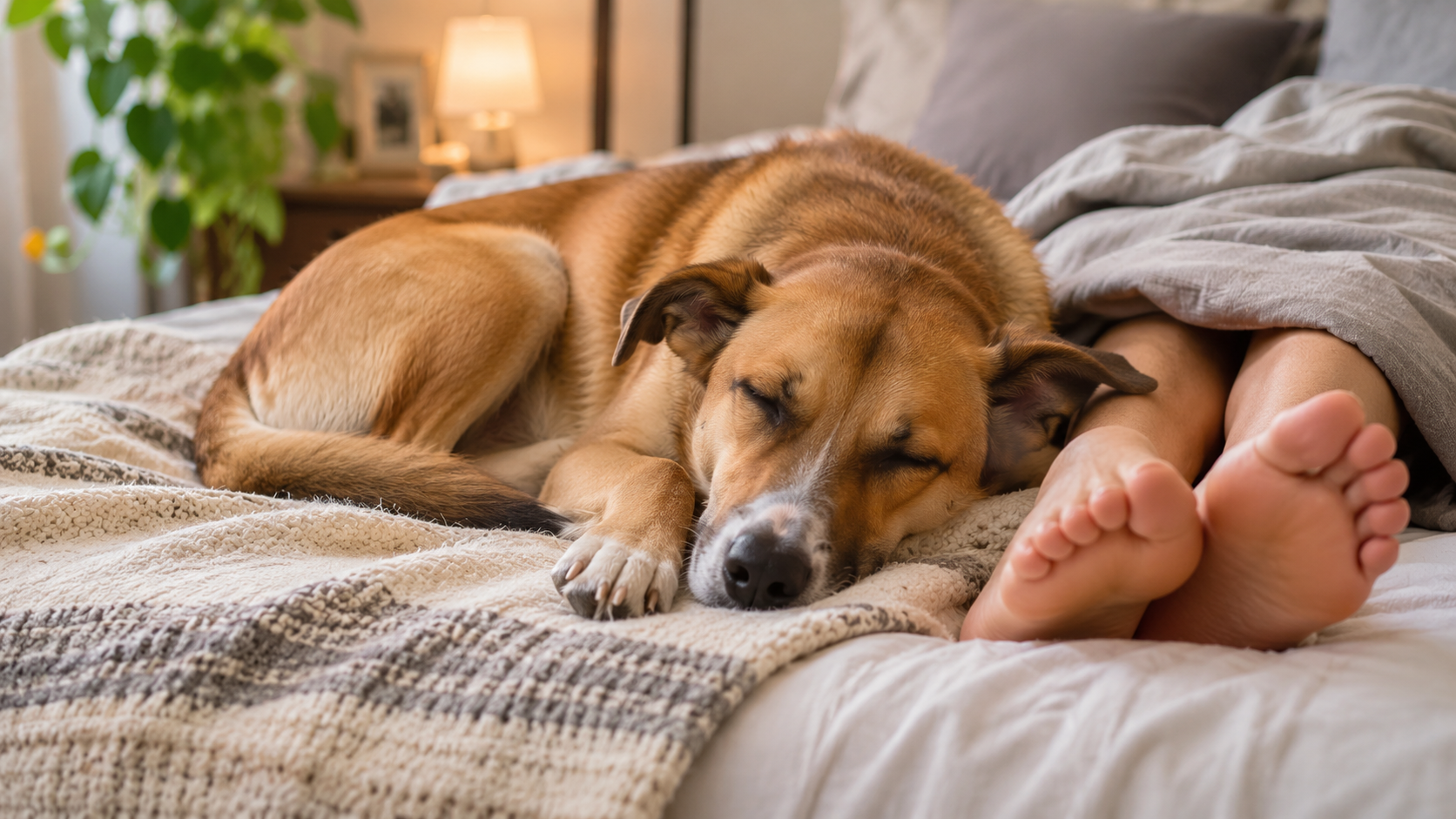
You turn off the lights, settle into bed, and a few moments later, your dog jumps onto the mattress, circles around, and curls up at your feet.
It's a familiar nighttime ritual for many dog owners. But why do dogs choose this particular spot when they have an entire bed, or even a comfortable sleeping area of their own?
Is it affection? Protection? An instinct inherited from their ancestors? Or simply a preference for a comfortable place to sleep?
The answer may involve several factors, including emotional attachment, physical comfort, security, and learned behavior.
Scientific research offers fascinating insights into the relationship between dogs, their owners, and sleep. However, researchers have not established a universal explanation for why dogs specifically choose the foot of the bed.
Let's explore what the evidence suggests, which explanations are plausible, and what your dog's sleeping habits may reveal.
The Short Answer: Why Does My Dog Sleep at My Feet?
Your dog may sleep at your feet because this position allows them to remain close to you while maintaining enough personal space to rest comfortably.
Your presence may provide reassurance, while the foot of the bed may offer a familiar and relatively undisturbed sleeping area.
For a relaxed dog that can also sleep independently, this behavior is generally not a cause for concern.
The exact motivation varies from dog to dog.
1. Your Presence May Help Your Dog Feel Secure
Dogs form meaningful social relationships with their human caregivers. These relationships can influence how they respond to unfamiliar situations and potentially how comfortably they rest.
A 2025 study published in the scientific journal Animals investigated canine sleep using non-invasive polysomnography, a method that records physiological activity associated with sleep.
Nine family dogs participated in sessions with either their owner or an unfamiliar person.
The researchers found that dogs fell asleep more readily and experienced more deep sleep when their owners were present.
Although the experiment was small and did not specifically examine sleeping at people's feet, its findings suggest that a familiar caregiver's presence can influence canine rest.
Your dog may therefore enjoy sleeping near you for reasons that extend beyond the comfort of your mattress.
2. Sleeping Near You May Reflect Emotional Attachment
Have you noticed that your dog sometimes follows you from room to room, even when nothing particularly interesting is happening?
This preference for staying nearby can reflect the social relationship you have developed together.
Dogs often learn that their caregivers provide food, companionship, predictable routines, opportunities for play, and reassurance during unfamiliar experiences.
At bedtime, remaining nearby may simply be another expression of that relationship.
However, sleeping at your feet is not a reliable way to measure how much your dog loves you.
A dog that prefers sleeping on the floor, in a separate bed, or across the room may share an equally strong emotional bond with their owner.
Individual preferences matter more than sleeping position alone.
3. The Foot of the Bed Offers Personal Space
Some dogs enjoy physical closeness without wanting continuous body contact.
The foot of the bed can offer a compromise: your dog remains close enough to benefit from your presence while having room to stretch, curl up, and reposition.
Depending on how you sleep, this area may also involve less contact with your arms, pillows, or upper body.
Imagine a medium-sized dog trying to find a comfortable position on a mattress already occupied by one or two people.
The foot of the bed may simply be the most convenient available space.
Observe whether your dog changes sleeping positions when you move your legs, rearrange the blankets, or sleep on a different side of the bed.
These small details may reveal that comfort and space are more important than any symbolic meaning attached to the position.
4. Temperature and Physical Comfort May Influence the Choice
Dogs do not necessarily choose the same sleeping spot throughout the year.
A thick-coated dog may prefer an exposed area of the mattress, while another dog may seek warmth beneath a blanket.
The foot of the bed might provide a comfortable balance between warmth and airflow, depending on the room temperature, bedding, and your dog's coat.
You may notice your dog moving to the floor during warmer nights and returning to your bed when temperatures drop.
This does not mean that your emotional relationship has changed.
It may simply reflect a different physical need.
Temperature is a plausible explanation for sleeping preferences, but it should not be presented as a scientifically established reason why dogs universally sleep at their owners' feet.
5. Your Dog May Have Developed a Learned Bedtime Habit
Dogs learn from repeated experiences and their consequences.
If your dog has slept at your feet for months without being disturbed, that location may have become a familiar part of their nighttime routine.
Perhaps you initially invited them onto the bed, offered affection when they settled down, or consistently allowed them to occupy the same spot.
Over time, the routine may have become self-reinforcing.
There does not need to be a reward every night. A comfortable, uninterrupted place to sleep can itself make a behavior more likely to continue.
This also helps explain why some dogs select the same corner of a sofa, the same rug, or the same place beside a person's chair every day.
Familiarity and predictability can help shape everyday behavior.
6. Your Dog May Prefer a Spot With Easy Access
Some dogs settle near the edge of a bed because they can get up, change positions, or leave more easily.
The foot of the bed might also provide a convenient view of the bedroom or doorway.
This is not necessarily evidence of a protective instinct.
It may be a practical preference related to movement, accessibility, or awareness of the surrounding environment.
Dogs that change locations frequently during the night may especially benefit from having an accessible sleeping area.
For older dogs or dogs with mobility difficulties, however, jumping on and off furniture can be challenging. A comfortable floor-level bed may be a better option.
7. Your Dog May Enjoy Staying Close to Their Social Group
Domestic dogs are social animals, and their relationships with humans can play an important role in their everyday lives.
Resting near familiar individuals may be part of how some dogs express their social preferences.
However, popular claims about dogs sleeping at their owners' feet to demonstrate submission, acknowledge an alpha leader, or protect the pack should be treated cautiously.
A sleeping position is not sufficient evidence of social rank or a protective intention.
If your dog is relaxed, comfortable, and able to leave whenever they choose, there is no reason to interpret ordinary bedtime behavior as a struggle for dominance.
What Science Actually Tells Us About Sleeping With Dogs
Research into human-dog sleep arrangements offers some surprising findings.
While scientists are still investigating the specific motivations behind canine sleeping locations, several studies have examined how sharing a sleeping environment affects both dogs and humans.
A Mayo Clinic Study Found That Sleeping Location Matters
In 2017, researchers published a study in Mayo Clinic Proceedings involving 40 healthy adults and their dogs.
Participants and their pets wore movement-monitoring devices for seven nights.
The researchers reported the following average sleep-efficiency measurements:
| Participants | Average Sleep Efficiency |
|---|---|
| Humans | 81% |
| Dogs | 85% |
Sleep efficiency measures the proportion of time spent in bed that is actually spent sleeping.
The researchers also found that human sleep efficiency was lower when the dog shared the mattress rather than sleeping elsewhere in the bedroom.
These findings suggest that keeping your dog nearby without necessarily sharing the same bed may be a reasonable compromise.
The percentages represent averages from this particular sample, not universal sleep-efficiency rates for dog owners or dogs.
Your Dog's Nighttime Movements May Influence Your Own
A 2020 study involving 12 women and their dogs examined movement patterns across 124 nights of shared sleep.
Researchers found that movement by the dog was associated with roughly three times the likelihood of the human beginning to move.
Interestingly, the participants rarely reported that their dogs had disturbed their sleep.
Movement-monitoring devices cannot establish whether every movement represents an awakening. Nevertheless, the results illustrate how perceived sleep quality can differ from objectively measured nighttime activity.
What the Evidence Supports — and What Remains Uncertain
Not every popular explanation has the same level of scientific support.
| Possible Explanation | What We Can Reasonably Say |
|---|---|
| Reassurance from the owner's presence | Supported by preliminary canine sleep research |
| Emotional attachment | Consistent with canine social behavior |
| Personal space and comfort | Plausible individual preference |
| Temperature regulation | Plausible physical explanation |
| Learned bedtime habits | Consistent with general learning principles |
| Easy access to and from the bed | Plausible practical preference |
| Guarding or protecting the owner | Cannot be established from sleeping position alone |
| Submission to an alpha leader | Not supported by sleeping position alone |
No single scientific study establishes that all dogs sleep at their owners' feet for the same reason.
Is Sleeping at Your Feet a Sign of Separation Anxiety?
Not necessarily.
An affectionate dog may enjoy sleeping close to their owner while remaining perfectly comfortable when left alone.
The important distinction is whether your dog can cope with separation.
A dog that rests peacefully in different locations, eats normally, and remains reasonably relaxed when you leave is not necessarily experiencing separation-related distress.
Potential warning signs include:
- Persistent barking or whining when left alone.
- Pacing or an inability to settle.
- Destructive behavior associated with departures.
- Excessive drooling or panting during separation.
- Attempts to escape from confined areas.
- Significant distress when the owner prepares to leave.
These behaviors can have different causes and should not be used individually to diagnose separation anxiety.
If your dog regularly shows significant distress when separated from you, consult your veterinarian or a qualified canine behavior professional.
A Five-Night Observation Exercise for Dog Owners
Rather than guessing what your dog's sleeping position means, try observing their preferences over five nights.
Maintain your normal bedtime routine and allow your dog to choose their resting spot voluntarily.
Record a few simple details each evening.
| Observation | What to Record |
|---|---|
| Sleeping location | Foot of bed, beside you, floor, or separate bed |
| Room temperature | Warm, cool, or comfortable |
| Physical contact | Touching you or resting independently |
| Nighttime movement | Frequent repositioning or settled sleep |
| Body language | Relaxed, restless, tense, or alert |
Look for recurring patterns.
Does your dog move away when the room becomes warmer? Do they prefer the foot of the bed when two people are sleeping in it? Do they relax equally well in their own bed nearby?
This exercise will not scientifically diagnose your dog's motivation, but it can help you understand their individual preferences.
Avoid deliberately frightening your dog or creating separation distress to test their attachment.
Should You Let Your Dog Sleep in Your Bed?
There is no universal answer.
For some households, sharing a bed with a dog is a comfortable and enjoyable arrangement.
For others, it can interfere with sleep, aggravate allergies, create hygiene concerns, or reduce personal space.
Consider whether:
- You and your dog sleep comfortably.
- Your dog can safely enter and leave the bed.
- Bedding is cleaned regularly.
- Your dog receives appropriate parasite prevention.
- Your dog respects personal space and does not guard the bed.
- Everyone sharing the bedroom is comfortable with the arrangement.
If you experience significant sleep problems or allergies, discuss your sleeping environment with a healthcare professional.
If your dog growls, snaps, or shows signs of discomfort when approached on the bed, avoid confrontational handling and seek professional guidance.
A separate sleeping area does not weaken an otherwise healthy relationship with your dog.
How to Encourage Your Dog to Sleep in Their Own Bed
If you prefer your dog to sleep independently, you can introduce a new bedtime routine using positive reinforcement.
Start by placing a comfortable dog bed close to your own bed.
Reward your dog when they voluntarily investigate or settle in the new area.
Use a consistent verbal cue, such as "bed," and pair it with calm encouragement.
Practice during the day, when there is less pressure to settle immediately.
Gradually build the amount of time your dog spends relaxing in their own sleeping area.
If your eventual goal is for your dog to sleep in another room, make location changes gradually and monitor their comfort.
Avoid punishment, shouting, or physically dragging your dog away from their preferred resting spot.
The goal is to create a positive alternative rather than make proximity to you associated with fear.
Frequently Asked Questions
Why does my dog sleep at the foot of my bed every night?
Your dog may find that spot familiar, comfortable, and reassuring. It allows them to remain close while maintaining personal space.
Does my dog sleep at my feet because they love me?
Emotional attachment may contribute to the behavior. However, sleeping location alone cannot measure affection or the strength of your relationship.
Is my dog protecting me when sleeping at my feet?
Possibly in some individual situations, but there is insufficient evidence to infer a protective motivation from sleeping position alone. Comfort, routine, and accessibility may be simpler explanations.
Why does my dog sleep at my feet instead of beside my head?
The foot of the bed may provide more room, a preferred temperature, or easier access. Each dog has different sleeping preferences.
Why has my dog suddenly stopped sleeping at my feet?
Changes in temperature, bedding, household routines, mobility, or physical comfort may influence sleeping preferences. Sudden changes accompanied by pain, lethargy, or unusual restlessness should be discussed with a veterinarian.
Does sleeping with my dog improve my sleep?
Some owners experience emotional comfort, but objective research suggests that sharing a mattress with a dog can also increase nighttime movement and reduce sleep efficiency. Individual experiences vary.
Will my dog feel rejected if I provide a separate bed?
Not necessarily. Introduce the new sleeping area gradually and positively while maintaining your usual companionship and affection.
Is it normal for a dog to sleep at my feet during the day?
Yes. Resting near a familiar person may reflect companionship, convenience, or a comfortable sleeping location.
Final Thoughts: Your Dog's Sleeping Spot Is Only Part of the Story
When your dog curls up at your feet, it is tempting to search for a hidden message behind the behavior.
But the most meaningful explanation may also be the simplest.
Your dog has found a familiar place where they can rest comfortably while remaining close to someone important in their life.
Scientific studies suggest that the presence of a familiar caregiver can influence canine sleep. Other research shows that sharing a sleeping environment can affect human nighttime activity.
What science has not established is a universal emotional or instinctive meaning for sleeping at a person's feet.
Instead of interpreting every sleeping position as a secret message, pay attention to your dog's overall behavior, comfort, health, and ability to relax independently.
Understanding those patterns can tell you much more about your relationship than a single sleeping position ever could.
Scientific References
-
Baranyai, L., Iotchev, I., Gombos, F., & Kis, A. (2025). Family Dogs' Sleep Macrostructure Reflects Worsened Sleep Quality When Sleeping in the Absence of Their Owners: A Non-Invasive Polysomnography Study. Animals, 15(21), 3182.
- DOI: 10.3390/ani15213182
- https://pmc.ncbi.nlm.nih.gov/articles/PMC12608857/
-
Patel, S. I., Miller, B. W., Kosiorek, H. E., Parish, J. M., Lyng, P. J., & Krahn, L. E. (2017). The Effect of Dogs on Human Sleep in the Home Sleep Environment. Mayo Clinic Proceedings, 92(9), 1368–1372.
- DOI: 10.1016/j.mayocp.2017.06.014
- https://pubmed.ncbi.nlm.nih.gov/28870354/
-
Hoffman, C. L., Browne, M., & Smith, B. P. (2020). Human-Animal Co-Sleeping: An Actigraphy-Based Assessment of Dogs' Impacts on Women's Nighttime Movements. Animals, 10(2), 278.
- DOI: 10.3390/ani10020278
- https://pmc.ncbi.nlm.nih.gov/articles/PMC7070703/ ,
Editorial note: This article distinguishes published scientific findings from plausible behavioral explanations. It is intended for educational purposes and does not replace professional veterinary or behavioral advice.
Last updated: November 25, 2026.